
WOMAN: I’m very pleased to welcome this evening’s guest speaker, Mark Logan, who’s going to tell us about the recent transformation of Minster Park. Over to you, Mark.
MARK: Thank you. I’m sure you’re all familiar with Minster Park. It’s been a feature of the city for well over a century, and has been the responsibility of the city council for most of that time. What perhaps isn’t so well known is the origin of the park: unlike many public parks that started in private ownership, as the garden of a large house, for instance, Minster was some waste land, which people living nearby started planting with flowers in 1892 【Q11】. It was unclear who actually owned the land, and this wasn’t settled until 20 years later, when the council took possession of it.
You may have noticed the statue near one of the entrances. It’s of Diane Gosforth, who played a key role in the history of the park. Once the council had become the legal owner, it planned to sell the land for housing. Many local people 【Q12】 wanted it to remain a place that everyone could go to, to enjoy the fresh air and natural environment – remember the park is in a densely populated residential area. Diane Gosforth was one of those people, and she organised petitions and demonstrations 【Q12】, which eventually made the council change its mind about the future of the land.
Soon after this the First World War broke out, in 1914, and most of the park was dug up and planted with vegetables 【Q13】, which were sold locally. At one stage the army considered taking in over for troop exercises and got as far as contacting the city council, then decided the park was too small to be of use. There were occasional public meetings during the war, in an area that had been retained as grass.
After the war, the park was turned back more or less to how it had been before 1914, and continued almost unchanged until recently. Plans for transforming it were drawn up at various times, most recently in 2013, though they were revised in 2015, before any work had started. The changes finally got going in 2016 【Q14】, and were finished on schedule last year.
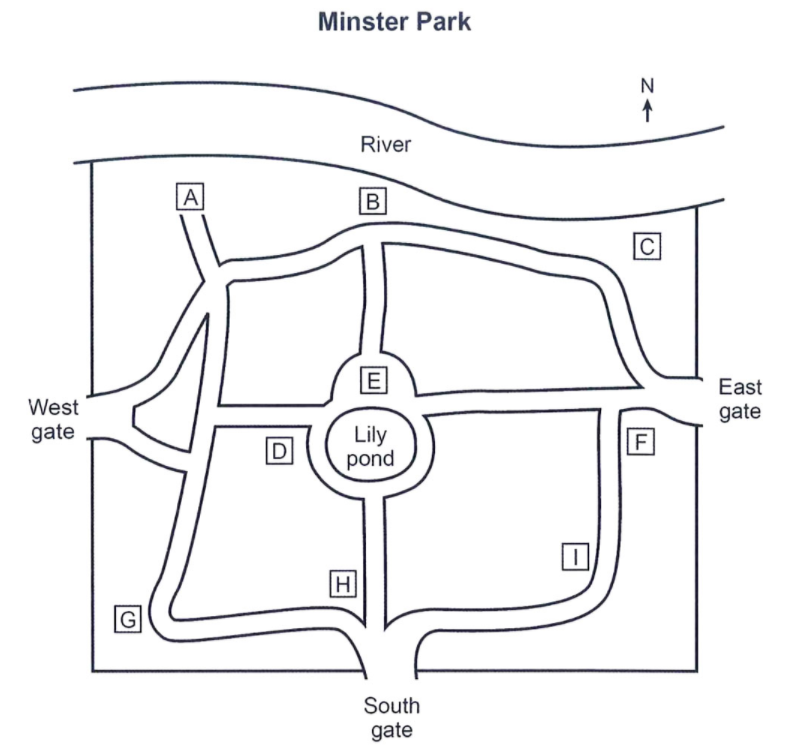
OK, let me tell you about some of the changes that have been made – and some things that have been retained. If you look at this map, you’ll see the familiar outline of the park, with the river forming the northern boundary, and a gate in each of the other three walls. The statue of Diane Gosforth has been moved: it used to be close to the south gate, but it’s now immediately to the north of the lily pond, almost in the centre of the park 【Q15】, which makes it much more visible.
There’s a new area of wooden sculptures, which are on the river bank, where the path from the east gate makes a sharp bend. 【Q16】
There are two areas that are particularly intended for children. The playground has been enlarged and improved, and that’s between the river and the path that leads from the pond to the river. 【Q17】
Then there’s a new maze, a circular series of paths, separated by low hedges. That’s near the west gate – you go north from there towards the river and then turn left to reach it. 【Q18】
There have been tennis courts in the park for many years, and they’ve been doubled, from four to eight. They’re still in the south-west corner of the park, where there’s a right-angle bend in the path. 【Q19】
Something else I’d like to mention is the new fitness area. This is right next to the lily pond on the same side as the west gate. 【Q20】
Now, as you’re all gardeners, I’m sure you’ll like to hear about the plants that have been chosen for the park.
Choose the correct letter, A, B or C.
听前预测: 限定词为 originally。
题目解析:本题没有较好的定位词,名词 park 为该部分的主题词,不能用于定位,所以需要理解题干的意思后再听题。在听到 the origin of the park 时可判断答案信息即将出现,答案句为:“... unlike many public parks that started in private ownership, as the garden of a large house ... which people living nearby started planting...” 此处首先听到选项B中的原词 private,但通过否定信号词 unlike 可排除B;后半句才是真正的答案信息,其中 people living nearby 替换了选项C中的 local community,故C正确;后面虽出现了选项A中的原词 council,但录音中说的是直到20年后才为 council 所有,与题干中要求的 originally 不符,且录音中未提到用作 amenity,因此答案为C
听前预测:定位词为 Diane Gosforth
解析:本题在定位上难度不大,但在指代用法与同义替换的考查上难度较大。定位词 Diane Gosforth 原词重现后,后面的两句先介绍了事情的北京,即市政委员会想把这块儿地改为住宅区,而当地居民希望它仍然是个公共场所;接着定位词第二次原词重现时引出答案句:“Diane Gosforth was one of those people, and she organised petitions and demonstrations...” 其中 those people 指代前面的 Many local people,同时对应选项A中的 resident,organised petitions and demonstrations对应选项A中的lead a campaign,因此答案为A。
听前预测:定位词为 First World War; 限定词为 mainly。
题目解析:本题的难点在于三个选项中的关键信息均在录音中出现,所以需要注意题干中的限定词 mainly,此处考查的是公园的主要用途。定位词 First World War 原词重现后,答案句随即出现:“... and most of the park was dug up and planted with vegetables, which were sold locally." 其中 most of the park 替换了题干中的限定词 mainly,planted with vegetables 替换了选项B中的 growing vegetables,故B正确;接着听到选项A的相关信息:“At one stage the army considered taking it over for troop exercises...” 通过后半句中的否定信号词 too small to be of use 可排除;之后听到选项C中的原词 public meetings:"There were occasional public meetings during the war...” 其中 occasional 与题干要求的 mainly不符,因此答案为B。
听前预测:定位词为 transformation; 限定词为 physical、begin。
题目解析:同上一题,本题的三个选项均在录音中出现,所以需要注意题干中的限定词 physical 和 begin,此处考查的是实体改造开始的时间。定位词 transformation 以动词形式出现后,首先听到选项A和选项B的相关信息:“Plans for transforming it were drawn up at various times, most recently in 2013, though they were revised in 2015...” 这两个时间分别为改造计划的起草时间和修改时间,与限定词 physical 不符,故排除;接着听到:“The changes finally got going in 2016..." 其中got going 意为“开始动工”,与限定词 physical 和 begin 相符,因此答案为C。